You’ve been invited to a Croatian wedding, or you’re standing on a Dalmatian street watching one go by, and you’re trying to figure out what’s about to happen.
This is the practical version. What the day actually looks like, what to wear, how much money to put in the envelope, and which traditions tend to catch foreign guests off guard.
A note before we start: Croatian weddings vary a lot. Region, family, religion, city vs village, modern vs traditional: all of it changes the script. What follows is the most common shape, not the only one. When in doubt, ask the person who invited you.

What happens at a Croatian wedding?
A Croatian wedding usually runs from the early afternoon until well past sunrise the next day. Guests gather at one of the family homes, the wedding party moves together to the ceremony, then everyone settles in for a long reception with food, music, dancing, more food, and a late-night second wind. Two hundred to three hundred guests is normal; a hundred is small.
That length is the part most foreign guests don’t expect. You’re committing to roughly twelve to fifteen hours of celebration, with several distinct chapters along the way.
Typical Croatian wedding timeline
Use this as a rough map. Times shift by region and family.
| Time | What’s happening | Where |
|---|---|---|
| Early afternoon | Pre-party at the groom’s family home: drinks, food, live music | Family house |
| Mid afternoon | Procession sets off for the bride’s gathering point | Streets / cars |
| Late afternoon | Ceremony (church or civil) | Church or registry |
| Evening | Reception begins: seated dinner, speeches, first dances | Restaurant or hall |
| Around midnight | Cake, gift-giving ritual at more traditional weddings | Reception |
| After midnight | Late-night food round, second wind on the dance floor | Reception |
| Early morning | After-party, often at a different venue | Bar / club / home |
If the invitation says 14:00, plan for the celebration itself to last well past 04:00. Pace yourself.
Traditions you might see before the ceremony
The wedding starts at one of the family homes, usually the groom’s, long before anyone heads to the church.
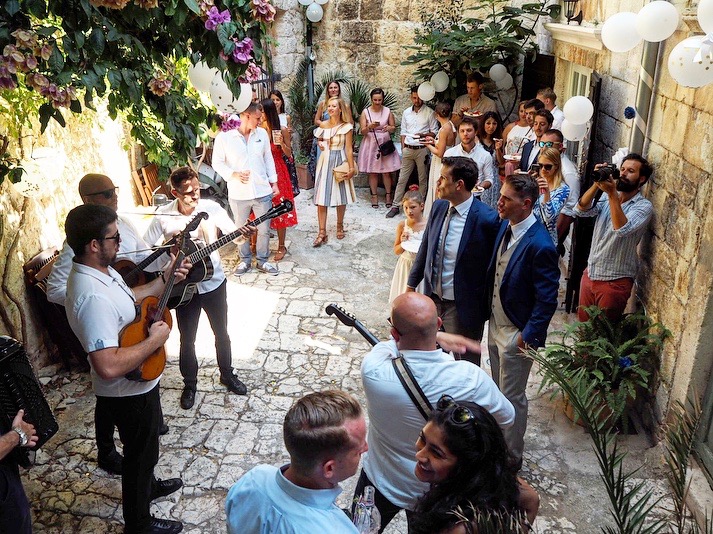
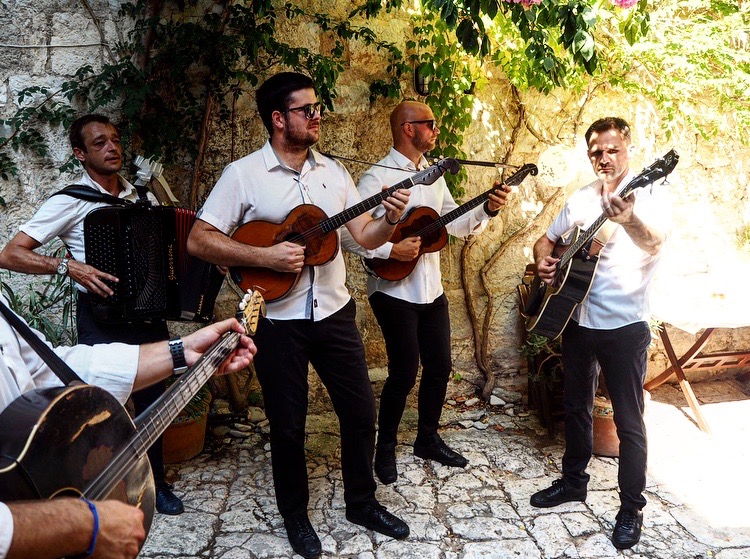
Tamburaši. A traditional band playing tambura, the long-necked Croatian stringed instrument. The music is loud, lively, and meant to set the tone for the whole day.
Rakija. A strong fruit brandy, often homemade, usually around 40–50% ABV. It’s served from a bottle decorated with the red, white and blue Croatian colours or the chequerboard emblem. People drink it neat. Pace yourself: the day is long and people genuinely will keep offering.
Pre-party food. Cold cuts, cheese, bread, salads. Designed to soak up the rakija before the main meal arrives much later.
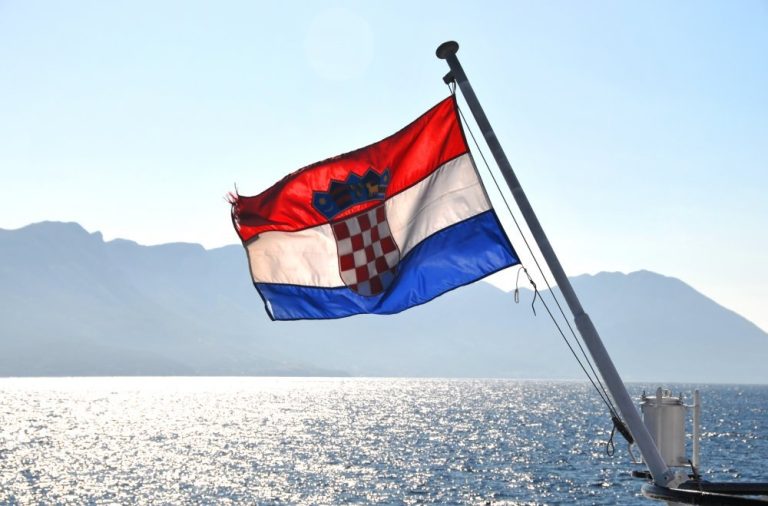
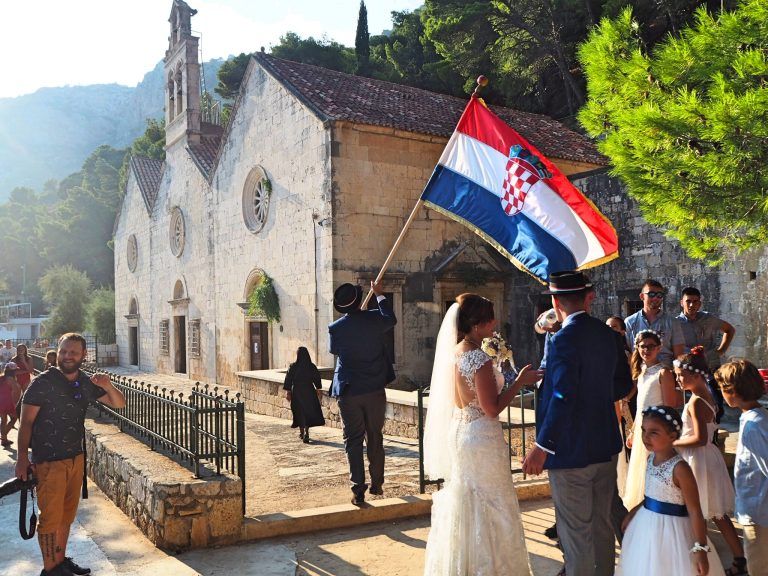
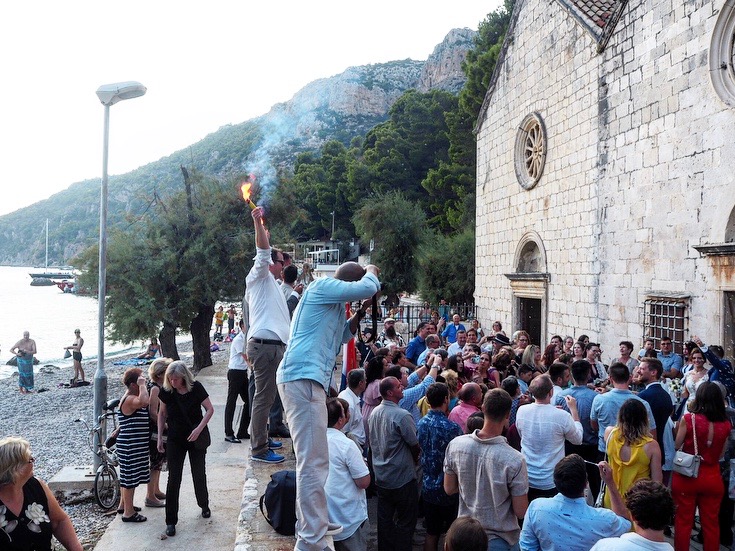
Barjaktar (flag carrier). A trusted friend or family member chosen by the groom to carry the Croatian flag throughout the day. They lead the wedding party from house to ceremony to reception. It’s an honour role. If someone introduces themselves as the barjaktar, that’s why they have a flag.
The procession. Once everyone is gathered and warmed up, the party moves toward the bride’s family home or another agreed meeting point. In small towns this is a noisy walk through the streets with the band playing. In bigger cities it’s a car convoy with horns, ribbons and flags. If you don’t have a car, ask. Someone will give you a lift.
The ceremony and reception
Most Croatian weddings are Catholic church ceremonies, with the rest at the registry office (matični ured). It’s one or the other, not both. A Catholic ceremony in Croatia is automatically registered with the state, so the couple doesn’t go to the matični ured separately. What follows the ceremony is similar either way.
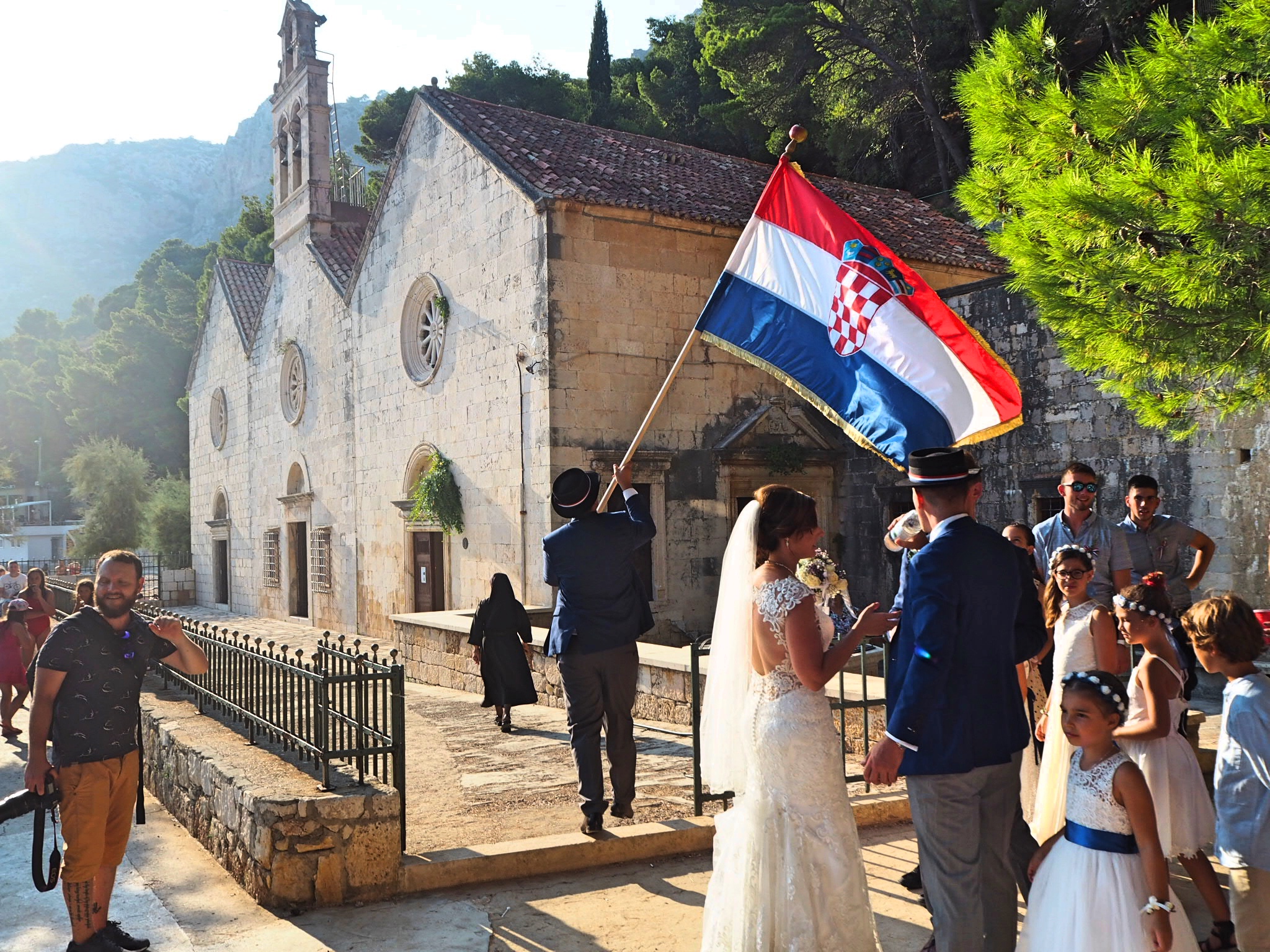
After the ceremony, expect a long, seated reception meal. Multiple courses arrive over several hours, interspersed with speeches, toasts, and live music. Don’t rush the early food. There will be more later.
Somewhere around midnight, depending on tradition, the couple cuts the cake. At more traditional weddings, this is also when the gifting ceremony happens: guests are invited up in turn to hand over their envelope and offer congratulations. At less traditional ones, there’s a discreet box somewhere near the entrance and you drop your envelope in whenever you arrive.
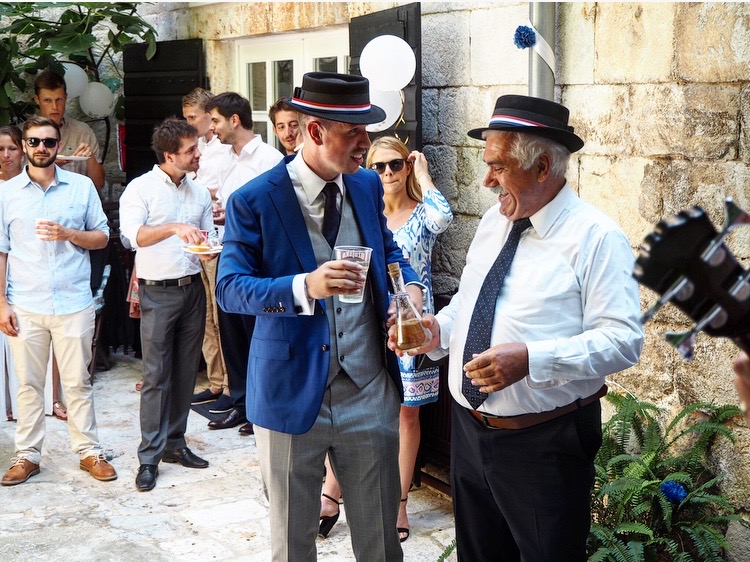
After midnight a fresh round of food usually appears, often grilled meats, sometimes traditional dishes like sarma, to give everyone a second wind. Then more dancing, until the wedding party migrates to an after-party venue, where things continue until the room empties around sunrise.
Wedding customs you might see
A few specific moments to watch for:
- The riža (rice) ritual, where guests throw rice (or, more often these days, flower petals or bubbles) as the couple leaves the church. The petals/bubbles trend isn’t about superstition, it’s that rice in your hair is annoying and modern brides have opinions.
- Sugar over the head instead of rice, in some families, said to bring sweetness to the marriage.
- A symbolic checkpoint at the bride’s house before the procession. Sometimes there’s a playful negotiation between the groom’s side and the bride’s family before they’re allowed inside.
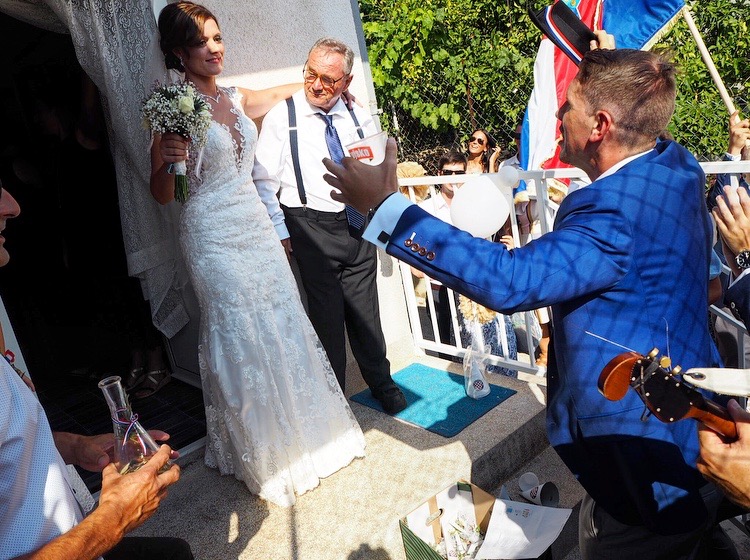
Not every wedding includes all of these. Watch what the locals do, and follow their lead.
What should you wear to a Croatian wedding?
The default is formal, leaning toward the dressier end. A few practical notes:
- Avoid white unless the couple has specifically said it’s fine. Same goes for very pale ivory or cream.
- Cocktail dress or suit is a safe baseline for most weddings. Beach or destination weddings in Dalmatia can lean a notch more relaxed. Ask the host.
- Comfortable shoes matter more than you’d think. Between the ceremony, the reception venue, and the after-party, you’ll likely walk and stand a lot. If you wear heels, bring a back-up pair in a bag.
- Bring a light layer. Churches can be cool, summer evenings on the coast can turn breezy, and the reception venue may have aggressive air conditioning.
- Modest for the church part: covered shoulders are respectful for a Catholic ceremony, even if the reception is more relaxed.
How much money should you give at a Croatian wedding?
Money in an envelope is the standard wedding gift in Croatia. There’s no fixed national amount. It depends on your relationship to the couple, the venue, the city or village, and your own budget.
The rough principle: the gift should comfortably cover the cost of your seat at the wedding (your dinner, drinks, share of the venue) plus a contribution toward the couple. A nicer venue means a higher cost per head, which guests tend to factor in.
In practice this means amounts vary widely, from modest in a small village wedding to substantially more at a destination wedding on the coast or in a high-end Zagreb venue. If you’re not sure what’s appropriate, ask someone close to the couple from the same circle (another guest, a mutual friend, a family member). It’s a normal question and nobody will think less of you for asking.
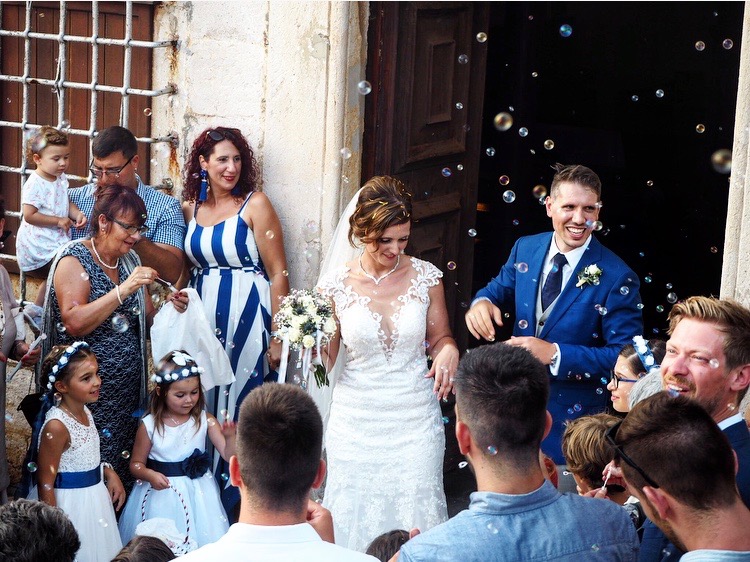
Put the cash in an envelope with a card. Bring it to the reception venue. Either drop it in the gift box near the entrance, or hold onto it for the gifting ceremony if the wedding follows that tradition.
What might surprise foreign guests?
Things that catch first-time foreign guests off guard, in roughly the order you’ll meet them:
- The length. Twelve to fifteen hours is normal. Eat throughout, hydrate, and don’t peak too early.
- Rakija at 2pm. Yes, it’s strong. Yes, it’s the start of the day, not the end. Sip, don’t shot.
- The noise of the procession. Honking convoys, flags, brass. Croatian weddings announce themselves.
- Long-form dinner. The seated meal is the heart of the event, not a quick stop before dancing. Multiple courses, multiple hours.
- The midnight reset. A second round of food and a fresh burst of dancing right when you thought it was winding down.
- The after-party. When the reception venue closes, the wedding doesn’t end. It relocates. If you’re invited, you’re invited to all of it.
- Energetic older relatives. Croatian grandmothers can outlast you on the dance floor. This is not a metaphor.
Frequently Asked Questions
Roughly 12–15 hours from the pre-party at the family home through the after-party. Plan to start in the early afternoon and finish sometime after sunrise.
Cocktail dress or suit as a baseline. Avoid white. Bring comfortable shoes and a light layer for the church or air-conditioned reception venue.
Yes, cash in an envelope is the standard wedding gift. The amount should comfortably cover the cost of your seat at the wedding plus a contribution toward the couple. Ask another guest if you’re unsure of the local norm.
A strong fruit brandy, often homemade, served from the start of the day. Around 40–50% alcohol. Sip it; don’t treat it like a shot.
The barjaktar is a trusted friend or family member chosen to carry the Croatian flag throughout the wedding day and lead the procession from family home to ceremony to reception.
Most are Catholic church weddings, though civil ceremonies at the registry office (matični ured) are also an option. It’s one or the other, not both: a Croatian church wedding is automatically registered with the state.
You came to find out what happens. Now you know. Show up rested, eat steadily, sip the rakija, and let the day take you where it wants to.
Where to stay in Croatia: search hotels on Booking.com.