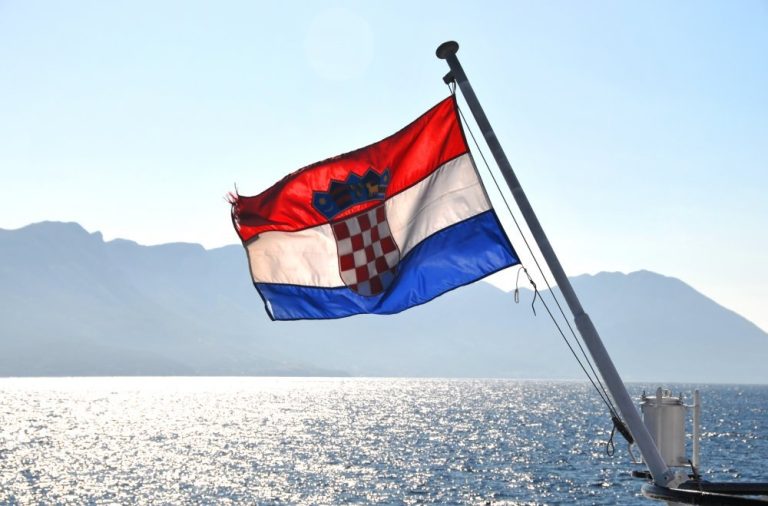
The Croatian flag is not just red, white and blue with a checkerboard in the middle.
The tricolor tells one part of Croatia's political history. The coat of arms tells another: older heraldry, regional identity, and the symbols Croatians still use at sports events, state ceremonies and weddings.
If you only want the short answer: the Croatian flag has three horizontal bands of red, white and blue, with the historical Croatian coat of arms in the center. The central shield has 25 red and white fields, and the five small shields above it represent historic Croatian lands and identities.
For more Croatian cultural context, pair this with the guide to Gljagolica, the old Slavic alphabet still visible in Croatia and the practical Croatian wedding traditions guide, where flags and national colors often show up in real celebrations.
Quick Answer: What Does the Croatian Flag Mean?
The Croatian flag represents the Republic of Croatia through three main elements: the red-white-blue tricolor, the red-and-white checkerboard shield, and the five smaller shields above the main coat of arms.
Legally, the Constitution describes the flag as red, white and blue, with the historical Croatian coat of arms in the center. It describes the coat of arms as a historical Croatian shield made from 25 alternating red and white fields.
| Flag element | What it is | What it represents |
| Red-white-blue stripes | Three horizontal color bands | Croatian national and political identity, connected to wider Slavic tricolor traditions |
| Main shield | 25 red and white fields | The historical Croatian coat of arms, often called the checkerboard |
| Five small shields | Crown-like row above the main shield | Historic Croatian regions and older heraldic symbols |
| Center placement | Coat of arms in the middle of the tricolor | The flag is not only a color flag; the heraldic shield is essential |
The important caveat: the colors are often given symbolic meanings online, but the official constitutional description does not say red means one thing, white another, and blue another. Treat those neat color explanations as later interpretation unless a source names the tradition clearly.
What Are the Colors of the Croatian Flag?
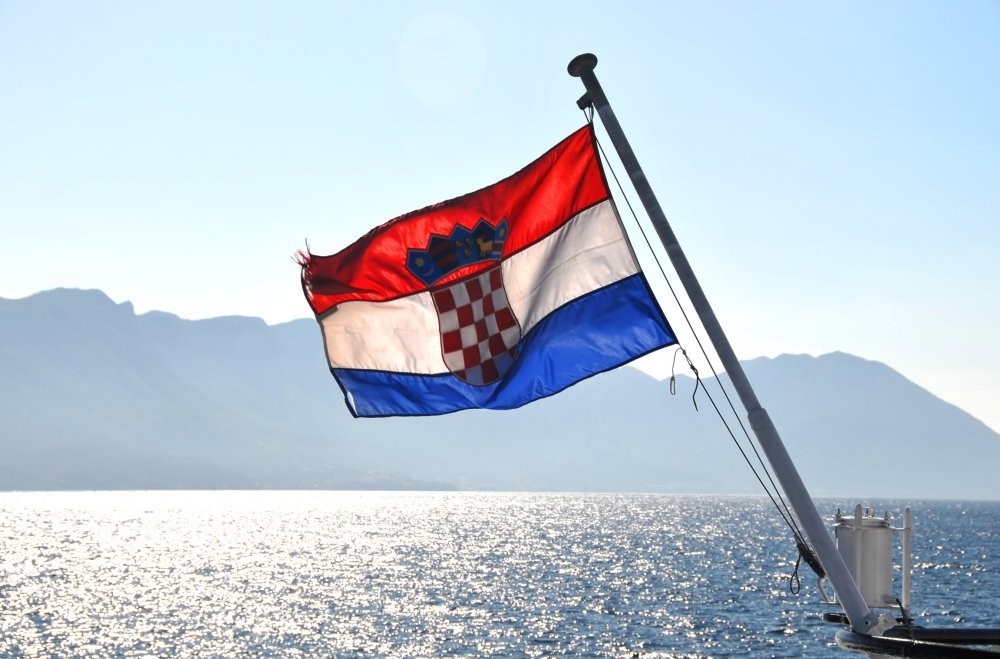
The Croatian flag uses three horizontal stripes: red on top, white in the middle and blue on the bottom.
These are often described as Pan-Slavic colors because red, white and blue appear on several Slavic national flags. In Croatia, the colors became politically important in the 19th century, especially around the 1848 national movement.
| Color | Position on the flag | Safer interpretation |
| Red | Top stripe | Part of the Croatian tricolor and wider Slavic color tradition |
| White | Middle stripe | Part of the Croatian tricolor and the coat of arms fields |
| Blue | Bottom stripe | Part of the Croatian tricolor and historic regional heraldry |
You will see simplified explanations saying red stands for blood, white for peace and blue for the Adriatic Sea. Those are easy to remember, but they are not the best explanation if you are trying to understand the flag historically.
The better answer is less poetic and more useful: the colors connect Croatia to 19th-century national identity and the wider red-white-blue family of Slavic flags, while the coat of arms gives the flag its specifically Croatian character.
What Is the Croatian Checkerboard?
The red-and-white checkerboard is the central shield of the Croatian coat of arms.
In Croatian, people often call it the šahovnica, meaning checkerboard. It has 25 alternating red and white fields, arranged in a 5-by-5 pattern.
This symbol is everywhere in Croatia. You see it on the national football shirt, state buildings, official documents, souvenirs, military insignia and flags at public events.
It is also the part of the flag visitors notice first. The tricolor may look similar to other European flags from a distance; the checkerboard makes it immediately Croatian.
What Do the Five Shields Above the Checkerboard Mean?
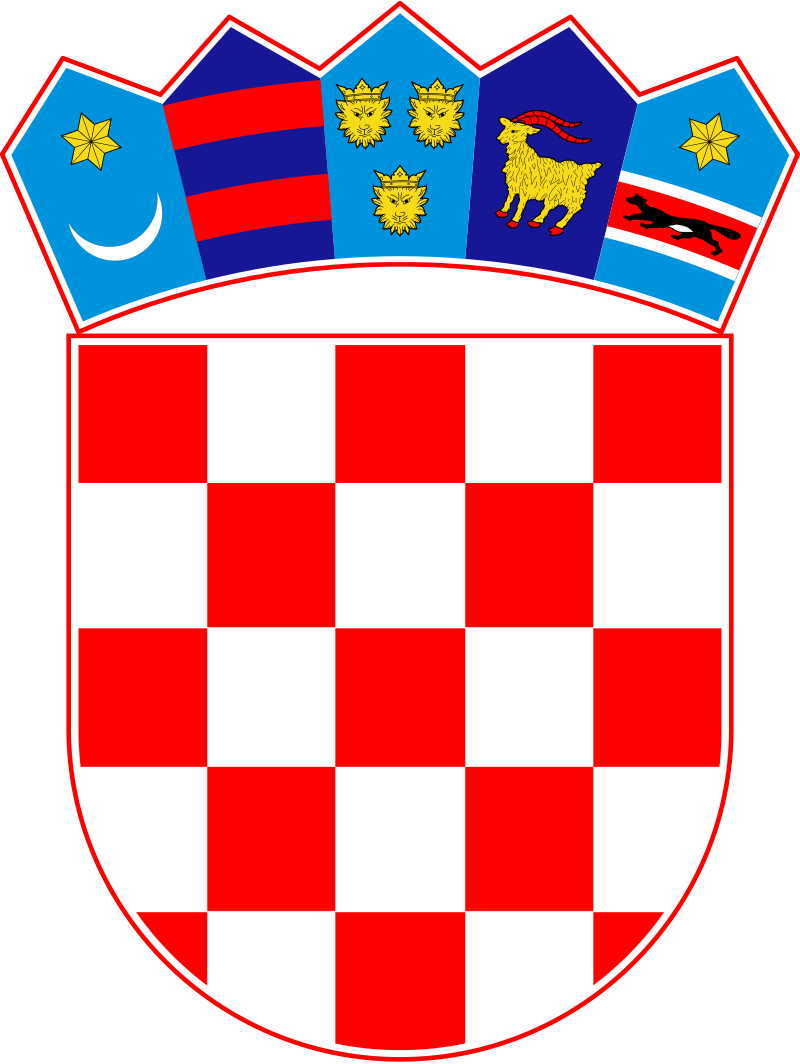
The five smaller shields above the main checkerboard form a crown-like row of historic symbols.
They represent older Croatian and regional heraldic identities. From left to right, they are commonly identified as the oldest known Croatian coat of arms, Dubrovnik, Dalmatia, Istria and Slavonia.
| Position | Shield | What visitors usually notice |
| 1 | Oldest known Croatian coat of arms | A star and crescent motif |
| 2 | Dubrovnik | Two red bars on blue |
| 3 | Dalmatia | Three crowned leopard or lion heads |
| 4 | Istria | A golden goat |
| 5 | Slavonia | A marten between two horizontal bands with a star above |
This is why the Croatian coat of arms looks more complicated than a simple national shield. It compresses several regional symbols into one state emblem.
That also makes it useful for travelers. If you visit Dubrovnik, Dalmatia, Istria or Slavonia, you are not only moving through modern regions; you are moving through names that sit inside the national coat of arms.
If you are planning culture-heavy stops, the Croatia UNESCO World Heritage Sites guide gives a good next layer: Dubrovnik, Split, Šibenik and Plitvice all show how symbols, architecture and state identity overlap in Croatia.
Why Is the Croatian Flag Red, White and Blue?
The red-white-blue tricolor became tied to Croatian political identity in the 19th century.
Britannica traces the choice of red-white-blue colors to Croatian nationalists in 1848, during a period when Croatia was under Hungarian rule and political movements across Europe were using flags as national symbols. The flag then remained associated with Croatian national aspirations.
That is the better historical frame than trying to assign one emotional meaning to each stripe.
The modern Croatian flag also carries the visual memory of different political periods. In socialist Yugoslavia, Croatia used a red-white-blue flag with a red star. In 1990, as Croatia moved toward independence, the star was removed and the historical coat of arms returned.
The current flag design, with the tricolor, checkerboard shield and five-shield crown, was adopted during the independence period in 1990.
Why Does the Croatian Flag Matter So Much in Daily Life?
The Croatian flag matters because it is used far beyond state buildings.
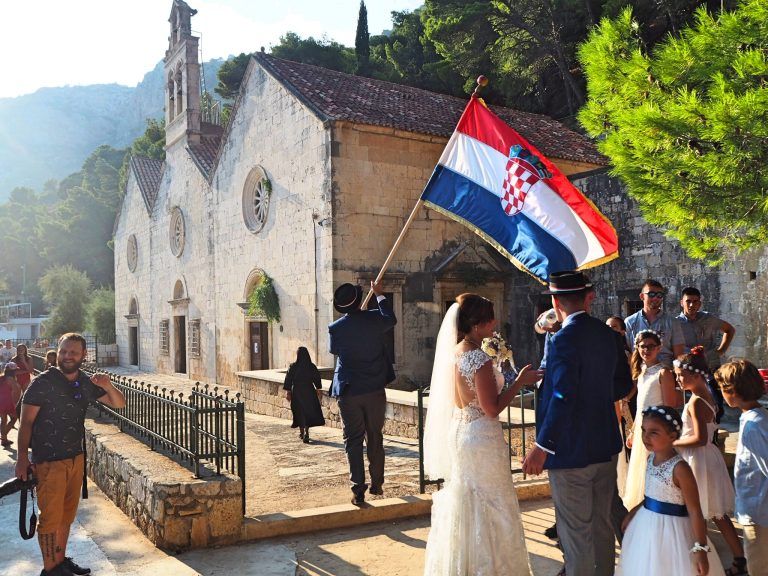
You see it at football matches, on cars during celebrations, in diaspora communities, at national holidays and sometimes at wedding processions. The red-and-white checkerboard is especially visible because it works almost like a shorthand for Croatian identity.
That is why visitors often notice the flag before they understand it. During a big football match, the checkerboard pattern can feel more common than the full flag itself.
There is a small trap here: the flag can look like a simple sports symbol if you only see it on shirts. It is much older and more layered than that. The sports use is modern visibility; the underlying shield is historical heraldry.
Is the Croatian Checkerboard Controversial?
The checkerboard itself is the official historical Croatian coat of arms, but some versions and political uses can be sensitive.
The problem is not the modern official coat of arms on the Croatian flag. The problem is that certain historical variants were also used by political regimes and movements, including the fascist Ustaša period during World War II.
For a visitor, the practical rule is simple: the official Croatian flag with the modern coat of arms is normal state symbolism. Do not assume every checkerboard is extremist. Also do not treat every historical variation as neutral if it appears in a political context.
Context matters more than the pattern alone.
Where Can You See Croatian Flag Symbols While Traveling?
You can see Croatian flag symbols almost anywhere, but some places make the history easier to understand.
Zagreb is the best starting point because it is the capital and home to Parliament, government buildings, museums and national ceremonies. The Zagreb travel guide is the natural next step if you want the flag's modern political context.
Dubrovnik, Dalmatia and Istria also matter because their historic symbols appear in the smaller shields above the checkerboard. That gives the coast more relevance than just beaches and old towns.
In daily life, the most visible symbol is still sport. Watch Croatia play football and you will understand how the checkerboard moved from heraldry into global pop culture.
Croatian Flag Meaning: Common Mistakes
The most common mistake is treating every part of the flag as a neat moral symbol.
Flags rarely work that cleanly. Croatia's flag is not best understood as "red means this, white means that, blue means that." It is better understood as a national tricolor combined with a historical coat of arms.
| Mistake | Better explanation |
| Each color has one official emotional meaning | The Constitution describes the colors but does not assign them moral meanings |
| The checkerboard is only a football design | It is the central historical Croatian coat of arms |
| The five shields are decorative | They refer to older Croatian and regional heraldic symbols |
| The modern flag is ancient unchanged | The current design belongs to the 1990 independence period, using older symbols |
| Any checkerboard use means the same thing | Context and historical version matter |
If you remember one thing, make it this: the colors make the flag a tricolor; the coat of arms makes it Croatian.
Frequently Asked Questions
What do the colors of the Croatian flag mean?
The Croatian flag has red, white and blue horizontal stripes. These colors are tied to Croatian national identity and the wider Slavic tricolor tradition. The official constitutional description names the colors but does not assign one fixed meaning to each stripe.
What is the symbol in the middle of the Croatian flag?
The symbol in the middle is the historical Croatian coat of arms. Its main shield has 25 alternating red and white fields, often called the Croatian checkerboard or šahovnica.
What do the five shields on the Croatian coat of arms represent?
The five shields above the checkerboard refer to historic Croatian and regional symbols. They are commonly identified as the oldest known Croatian coat of arms, Dubrovnik, Dalmatia, Istria and Slavonia.
When was the current Croatian flag adopted?
The current Croatian flag design belongs to the 1990 independence period. It replaced the socialist-era red star with the historical Croatian coat of arms and added the five-shield crown above the main checkerboard shield.
Why is there a checkerboard on the Croatian flag?
The checkerboard is the historical Croatian coat of arms. It is one of the country's most recognizable symbols and appears far beyond the flag, including on sports shirts, official emblems and public celebrations.
Is the Croatian checkerboard the same as the football shirt pattern?
The football shirt uses the same national visual language, but it is a sports design based on the older coat-of-arms symbol. The checkerboard did not come from football; football made it globally recognizable.
Where to stay in Croatia: search hotels on Booking.com.